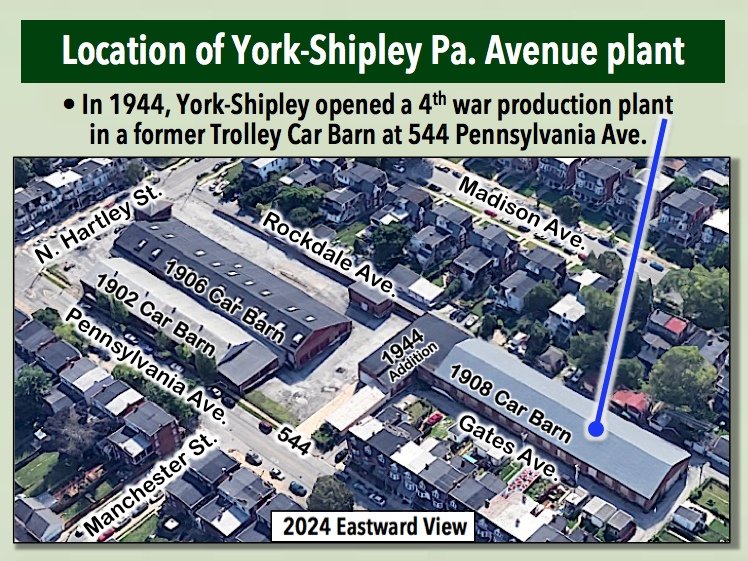
An eastward looking aerial view is used to illustrate location of a WWII war production plant of York-Shipley in a former Trolley Car Barn at 544 Pennsylvania Avenue. Slide is from S.H. Smith presentation for York Home Front: WWII Briefings of May 11, 2024. (2024 Google Earth, Annotated by S.H. Smith 2024)
Trolley Car Barn was a WWII York-Shipley factory
A presentation prepared last year included a short glimpse of a York Trolley Car Barn used as a York-Shipley war production factory. A few of those slides serve as a nice introduction to addition research addressing recent queries about the Car Barns and about that York-Shipley plant.
The presentation uses my parents, Harold and Esther (Barshinger) Smith, as examples. While Harold Smith served 3-yrs, 1-mo. in the Army Air Forces during WWII, the following general introductory slide lists the four York area war production factories where his wife Esther worked.

Side-by-side timelines for Esther and Harold Smith served as introductory slide for five home front topics where four sections only contain one slide, such as the introductory slide locating the York-Shipley plant in the former trolley car barn. In the presentation the GE Plant is the featured topic with multiple slides. The title of that presentation in York Home Front: WWII Briefings of May 11, 2024 is: “Not just a stick of gum! York’s GE plant and the Bazooka.”
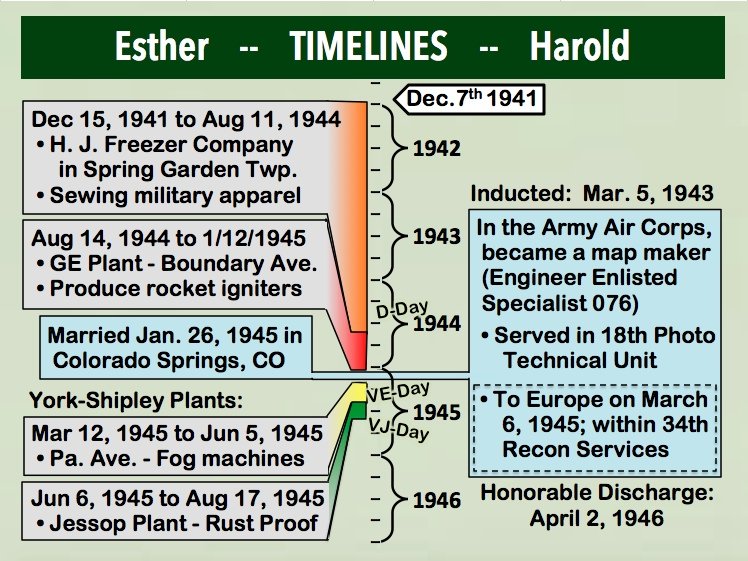
Discovery of Mom’s Home Front workplaces
It was through my model rocketry hobby, in my early teens during the 1960s, that I learned about Mom producing rocket igniters for the Bazooka. Most model rockets at that time were electrically fired using batteries, just like the initial bazookas.
Our model rocket group was constantly replacing batteries when Mom suggested we try to find a surplus Bazooka rocket igniter that was made in York during the war, since it did not require batteries. Mom started describing how the magneto worked in that igniter and that if we found one at an Army surplus store, she knew how to take it apart and lower the output current for our group to use to ignite model rocket engines. An ensuing discussion revealed the four locations and what Mom did in producing items at those York plants for the WWII war effort.
Working at the York-Shipley plants
Esther Smith worked at the York-Shipley plant at 544 Pennsylvania Avenue from March 12, 1945 to June 5, 1945. She initially was on the assembly line; installing two pieces of tubing, on each fog machine as it stopped at her station. A special torque wrench was used to tighten the fittings. During the last few weeks, she worked in the spare parts department, either in quality inspection or packaging.
Towards the end of May, Mom was informed, June 5 would be her last day at the Pennsylvania Avenue plant. However a need existed for individuals on the rust proofing line at York Shipley’s Jessop Plant; where Mom started June 6, 1945 and worked there until August 17, 1945.
Short history of the Trolley Car Barns in York
I wrote an article for the 2024 Journal of York County Heritage about trolleys in York County. That journal article starts at page 29 of the on-line journal available at this Link. Due to limits on article length, not all of my trolley research was included in the article. Here I’m sharing those research details associated with the Trolley Car Barns.
Enough rails were placed in York streets between June and September of 1886 for the York Street Railway Company to begin regularly scheduled service of horse-drawn streetcars on September 30, 1886. The horses and mules utilized by these streetcars were stabled in frame barns at the southwest corner of North Hartley and Harrison (later renamed Pennsylvania) Avenue. At that time, this property was just outside city limits in West Manchester Township. The streetcars were also housed at that location in similar frame barns; known as car barns.
After the York Street Railway Company converted to operation by electric streetcars on August 18, 1892, a public sale of their horses, mules, harnesses, and stable tools was held September 28, 1892. The sale of all their 85-horses and 11-mules allowed all stable barns to be converted to car barns.
The utilization of wood frame car barns to house electric trolley cars, that were prone at creating open sparks, often caused fires of varying degree. After some major trolley barn fires happened around the country, most locations replaced their frame car barns with structures built of brick or concrete.
Between 1902 and 1908 the York Street Railway Company completed three brick car barns, which still stand at the corner of North Hartley Street and Pennsylvania Avenue. Directly at the corner, the first brick car barn was started in 1901 and completed in 1902; it was capable of housing twenty trolley cars.
Tom Gibson submitted a photo of a sketch of the trolley track layout at the car barns. He took this photo during a recent visit to Capitol Screw and Nut Company, who occupy the former 1902 and 1906 Car Barns. I added my annotations in the right column.
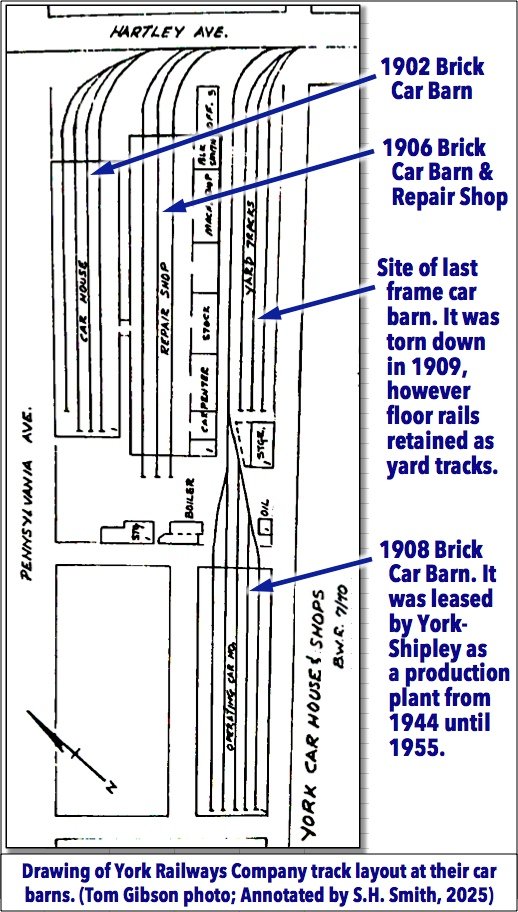
Just south of the 1902 car barn and connected to a small office tower along North Hartley Street, the first phase of a car repair barn was put under roof in 1906. In some news articles this brick car barn is referred to as a car hospital, where at least a dozen cars can be under repair at one time. Inside the south wall of that car barn are: a machine shop, a blacksmith shop, an electrical shop, a carpenter shop, a paint shop, and there are avenues underground to work below the floors of the trolleys. Hamme and Leber are the architects for the 1906 Car Barn.
For rail access to the third brick car barn, a single track was placed from Hartley Street, running between the south wall of the 1906 car barn and the last remaining frame car barn which extended lengthwise along Rockdale Avenue, to allow trolley cars to access the 1908 car barn. That car barn was capable of housing twenty of the larger trolley cars.
York Railways Company Bankruptcy
In its final years of operation, York trolley operations were consistently in the red until on November 30, 1937, York Railways Company was forced to file for Bankruptcy. In compliance with a plan of reorganization provided for under section 77B of the federal bankruptcy act, York was given time to put in place a suitable substitute bus system prior to the final shutdown of all trolley operations at end of business day on February 4, 1939.
The plan of reorganization also mandated a trustees’ sale of all physical properties of the York Railways Company to be put on the auction block by March 14, 1939. This auction included everything from the miles of rails, to copper overhead wire strung over the trolley routes throughout the county, to the repair equipment in the 1906 car barn, to 49 trolley passenger cars.

While the sale of the 2.1-acre property, on which the three brick car barns sat, at the corner of North Hartley Street and Pennsylvania Avenue was tied up in litigation, the York Bus Company utilized those car barns as garages.
In November 1941, the sale of the 2.1-acre property, with three car barns and improvements, was allowed to proceed. On November 28, 1941, the buyers were George A. Stevens, C. E. Wickman, H. L. Bollum, all of Chicago, Illinois and W. S. T. Hurlock, Jr. of Harrisburg, Pennsylvania. The York Bus Company continued leasing all three car barns until early 1944, when York-Shipley obtained a lease for the 1908 Car Barn property along with access to Pennsylvania Avenue.
York-Shipley’s Pennsylvania Avenue Plant
Frederick J. Rempp is the architect hired by York-Shipley for converting the car barn into a production facility. A few years later Fred Rempp is the architect for Haines Shoe House, however he also designed numerous factories, schools and churches in the York area. The contractors for this project are Stewart and March.
Shortly after the conversion was completed, Marest, Inc. is the new owner of the former 1908 car barn property. This corporation is owned by three York individuals with equal undivided one-third interest in the property: Luther D. March, Frederick J. Rempp, and Robert H. Stewart. Look at the first two letters of their surnames, and you will discover how the name Marest was selected. Today, Marest, Inc. remains the owner of that property at 544 Pennsylvania Avenue, which presently appears to be utilized as a warehouse.
The following York Dispatch article of April 15, 1944 describes how the former 1908 car barn was converted for use as the fourth York-Shipley plant for war production.
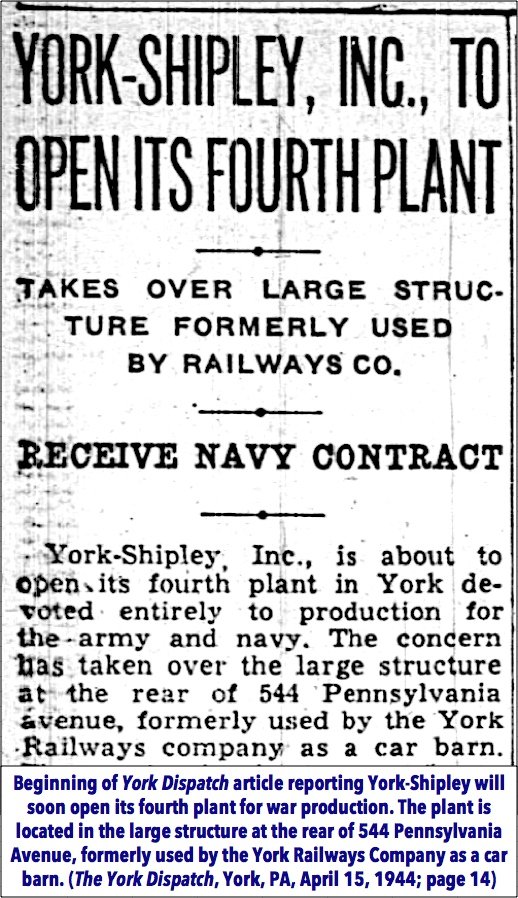
Quoting the text of the whole York-Shipley article in the April 15, 1944 issue of The York Dispatch, page 14: “York-Shipley, Inc., is about to open its fourth plant in York devoted entirely to production for the army and navy. The concern has taken over the large structure at the rear of 544 Pennsylvania Avenue, formerly used by the York Railways Company as a car barn. There extensive improvements are now under way with the expectation that the plant will be ready for production by the end of the month.”
“Last month York-Shipley received a contract from the U.S. Navy department for the assembly of a fog-type smoke generator. Details of the machine to be made are not available for publication because of war-time restrictions. It is because of this contract that extra manufacturing space was needed.”
“The building to be used is a one-story brick structure with more than 14,000 square feet of floor-space. When alterations, which include installation of rest rooms, wash rooms, parts stock rooms, floor repairs, painting and other improvements, are completed the construction of the smoke generators will begin. There will be employment for from 20 to 50 persons.”
“The project is one of streamlined assembly and it will be operated by the use of motor driven dollies. These will start at one end of the building, move its length, and then back to the other. When that point is reached assembly will be complete. Workmen will add necessary parts as the dollies move along. During the entire process there will be frequent inspections. One out of every so many completed will have to be inspected and tested in the open for efficient operation.”
“Fred Rempp is the architect in charge of the extensive improvements now being made. Charles (Red) Arthur will be the production manager in the new plant and Samuel Spiese will be the foreman.”
“York-Shipley now operates plants off King’s Mill Road, the original site of the York Oil Burner Company, which is know as the boring mill; another on Roosevelt Avenue and the Pennsylvania Railroad, and the third at Jessop Place and the Pennsylvania Railroad. All are engaged in carrying out government contracts for prosecution of the war, at present mostly for use of the navy.”
Details about the Fog Machine
Esther Smith was emphatic about being involved in the assembly of a fog machine and that it was not a smoke generator. Supposedly York-Shipley engineers worked with a university, and that collaboration resulted in a unique design, which was the reason York-Shipley got the manufacturing contracts.
It was said the intended use of these fog machines was to cloud naval activities leading up to and during the invasion of the Japanese mainland. Further research is included in Part 2 of this York-Shipley story.
Click on this LINK for a yorkblog.com Full View of the photos and illustrations in this post.
Links to related posts:
WWII Fog Machines by York-Shipley
Home Front gudgeons during WWII
GE plant in York produced rocket igniters
Esther Smith Christmas Portraits during WWII
Army and Navy apparel made by the H. J. Freezer Company
H. J. Freezer plant location in Spring Garden Township
Reading the Headlines: A Quick Index to All YorksPast Posts


