
York-Hession Model H-106 Fog Generating Machine was designed by John Hession, Jr. at Columbia University; with the concept refined for manufacturing by York-Shipley. It was produced at their 544 Pennsylvania Avenue Plant in York, PA. The intended use was to cloud naval activities leading up to and during the invasion of the Japanese mainland.
WWII Fog Machines by York-Shipley
Esther Smith worked at four Home Front industries in York, Pennsylvania during World War II. Her job on the fog machine assembly line at the 544 Pennsylvania Avenue plant of York-Shipley, allowed sharing enough things that allowed discovering more about those fog machines intended to cloud naval activities leading up to and during the invasion of the Japanese mainland.
Esther Smith was emphatic about being involved in the assembly of a fog machine and that it was not a smoke generator. Supposedly York-Shipley engineers worked with a university, and that collaboration resulted in a unique design, which was the reason York-Shipley was awarded the manufacturing contracts. She described a fire hydrant shaped machine with a domed top containing three small nozzles, and that it was connected in multiple ways to a pull start gasoline engine.
An Internet search resulted in the discovery of photos of a York-Hession Model H-106 Fog Generating Machine displayed at last years World War II Weekend event at the Reading Regional Airport in Reading, PA. That annual event was hosted by The Mid-Atlantic Air Museum from June 6 through 8, 2025. The nameplate provided the name and model, with it being manufactured by York-Shipley in York, PA.
Other museums were discovered that have these fog machines in their collections. In the montage at the beginning of this post, that York-Hession Model H-106 Fog Machine is in the collections of the National Museum of Military Vehicles in Dubois, Wyoming.
Esther Smith’s Home Front workplaces
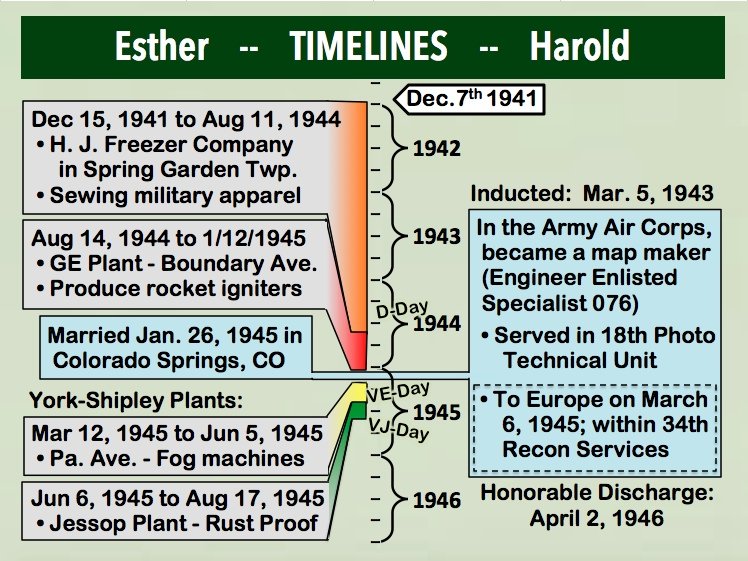
Side-by-side timelines for Esther and Harold Smith served as an introductory slide for five home front topics where four sections only contain one slide, such as an introductory slide locating the York-Shipley plant in a former trolley car barn, that I wrote about last month in the post at this Link.
The following slide is from a 2024 presentation where the GE Plant is the featured topic. The title of that presentation in York Home Front: WWII Briefings of May 11, 2024 is: “Not just a stick of gum! York’s GE plant and the Bazooka.”
It was through my model rocketry hobby, in my early teens during the 1960s, that I learned about Mom producing rocket igniters for the Bazooka. Most model rockets at that time were electrically fired using batteries, just like the initial bazookas.
Our model rocket group was constantly replacing batteries when Mom suggested we try to find a surplus Bazooka rocket igniter that was made in York during the war, since it did not require batteries. Mom started describing how the magneto worked in that igniter and that if we found one at an Army surplus store, she knew how to take it apart and lower the output current for our group to use to ignite model rocket engines.
An ensuing discussion revealed the four locations and what Mom did in producing items at those York plants for the WWII war effort. Years later, just after Dad passed away, I revisited those discussions with Mom and got additional details.
York-Hession Model H-106 Fog Generating Machine
The fog machine, at the 2025 World War II Weekend in Reading, was displayed with a 55-gallon barrel marked US Navy Fog Oil likely to signify specialty distilled fog oil was required with the machine to create a persistent fog. If the prescribed oil was used, the fog machine repeatedly operated producing desired fog clouds. However if other oils were used, the fog was not as thick and some oils even caused various nozzles to clog.
There was a room inside York-Shipley’s Pennsylvania Avenue Plant where the fog machines were tested. When Esther Smith worked at that plant, that room was also being used to check if various other oils worked satisfactorily. Mom stated she could still hear the man in charge of that test room, exclaiming in disgust, “If you have a gasoline engine, why would you put other fluids in it and expect it to work. Then why doesn’t the Navy just train everybody to only use the assigned fog oil, rather than testing all Army and Navy oils, because most of them ruin our fog machines.”

The following photo shows the central section of General Operating Instructions plate attached to the York-Hession Model H-106 Combustion Fog Generating Machine manufactured by York-Shipley, Inc. At the bottom are the phrases: “Designed by Columbia University and N.D.R.C.” and “Patents Applied For.” Those phrases resulted in searches into a Hession connection at Columbia University. National Defense Research Committee (N.D.R.C.) records revealed John W. Hession, Jr. was an independent researcher working at Columbia University on fog generating technology.

Another find was an Operating Instructions and Parts List for the York-Hession Model H-106 Fog Generating Machine. It was discovered on a WW2 relics and archaeology Facebook post of August 25, 2023; asking what the machine and manual is worth. Bryce Judy noted “Inside the book it says it was a naval contract and that all documents are classified, etc. etc., dated April 1944.”

A patent search revealed the United States Patent issued to John W. Hession, Jr. for a mechanical aerosol generator served as the core design element in the York-Hession Model H-106 Combustion Fog Generating Machine. This patent was applied for on May 24, 1944, however due to its classified nature during and following WWII, the patent application was held by the Patent Office and was not granted until 1952.

Quoting the first paragraph of Patent No. 2,607,743 granted to John W. Hession, Jr.: “My invention relates to a machine for the generation of an aerosol composed of any one of various materials and its distribution into the atmosphere in the form of a cloud useful for a number of purposes, such as the concealment of ships at sea, or troops on land or sea, or protective operations of the various kinds.” The patent includes eight claims related to why the machine will produce a persistent fog.
York-Shipley engineers collaborated with John Hession, Jr. to quickly convert his conceptual fog machine into a refined design suitable for manufacturing. Resulting in the York-Hession Model H-106 Combustion Fog Generating Machine. York Shipley, Inc. held four major Navy contracts, totaling approximately $900,000, for the development and production of these fog generators.
Working at York-Shipley’s Jessop Place plant
Towards the end of May 1945, Esther Smith was informed, June 5 would be her last day at the Pennsylvania Avenue plant working on fog machines. However a need existed for individuals on the rust proofing line at York Shipley’s Jessop Place plant; where Mom started work on June 6, 1945.
The location of York-Shipley’s Jessop Place plant is indicated via following 1955 photo of the plant’s north side and an annotated 1947 aerial photo showing the viewpoint for that photo. The oldest parts of that plant, at the north side, no longer stand. Some buildings from the south side of the York-Shipley plant are among the complex of buildings presently housing IRS Industrial Recovery Services at 365 West Cottage Place.

Esther Smith worked in the department applying a waxy rust preventative coating, likely Cosmoline, to tank parts produced at the Jessop Place plant. York-Shipley was a subcontractor for army tank manufacturers; producing items such as axles, gudgeons, and track-locking parts.
The Jessop Place plant was also involved in making roller race assemblies for .30 and .50 caliber gun mounts installed on Navy landing barges and PT boats. Plus, they manufactured turret rings for plants producing Bofors 40mm guns. More details about the range of war materials produced at the Jessop Place plant is at this link .
With President Truman’s announcement of Japan’s surrender on Tuesday August 14, 1945, all York-Shipley plants were closed the following day. When Mom returned to work on August 16 she was informed because she was in the group with the lowest seniority, August 17 was her last day of work.
Click on this LINK for a yorkblog.com Full View of the photos and illustrations in this post.
Links to related posts:
Home Front gudgeons during WWII
Trolley Car Barn was a WWII York-Shipley factory
GE plant in York produced rocket igniters
Esther Smith Christmas Portraits during WWII
Army and Navy apparel made by the H. J. Freezer Company
H. J. Freezer plant location in Spring Garden Township
Reading the Headlines: A Quick Index to All YorksPast Posts


